Any casual reader of Indian history would have come across the years of significant Muslim and Christian presence in India. Particularly, the Delhi Sultanate (1200s-1500s), the Mughal Empire (1500s-1800s) and then the British Christian rule (1700s-1900s). Said to be a total of around 600 years of Muslim rule and 200 years of Christian rule in India. This is quite a significant idea for someone to come face to face with: a proud civilization such as India – with Hinduism or Sanatana Dharma – being under the thumb of foreign powers for so long. What I wish to do in this essay is focus on just one of these periods. Perhaps I can speak on the others in the future. However I wish to, in particular, speak on the Delhi Sultanate period and bring to light and synthesize what may be little known viewpoints and information that challenges the idea that the Delhi Sultanate was a long period of Muslim rule in the Indian subcontinent. I also wish to bring to light what may be little known information and viewpoints on the Hindu resistance to the Delhi Sultanate, and also different facets of the Hindu-Muslim power dynamics during the Delhi Sultanate.
The Delhi Sultanate was a period of foreign Turkish Muslim incursions and presence in the Indian Subcontinent. To start with, there is a book called The Delhi Sultanate by Bharatiya Vidya Bhavan. Bharatiya Vidya Bhavan is an educational trust. This book is an in depth look at the Delhi Sultanate with multiple authors. One part I would like to bring to your attention is by General Editor R.C. Majumdar in the Preface of the book:
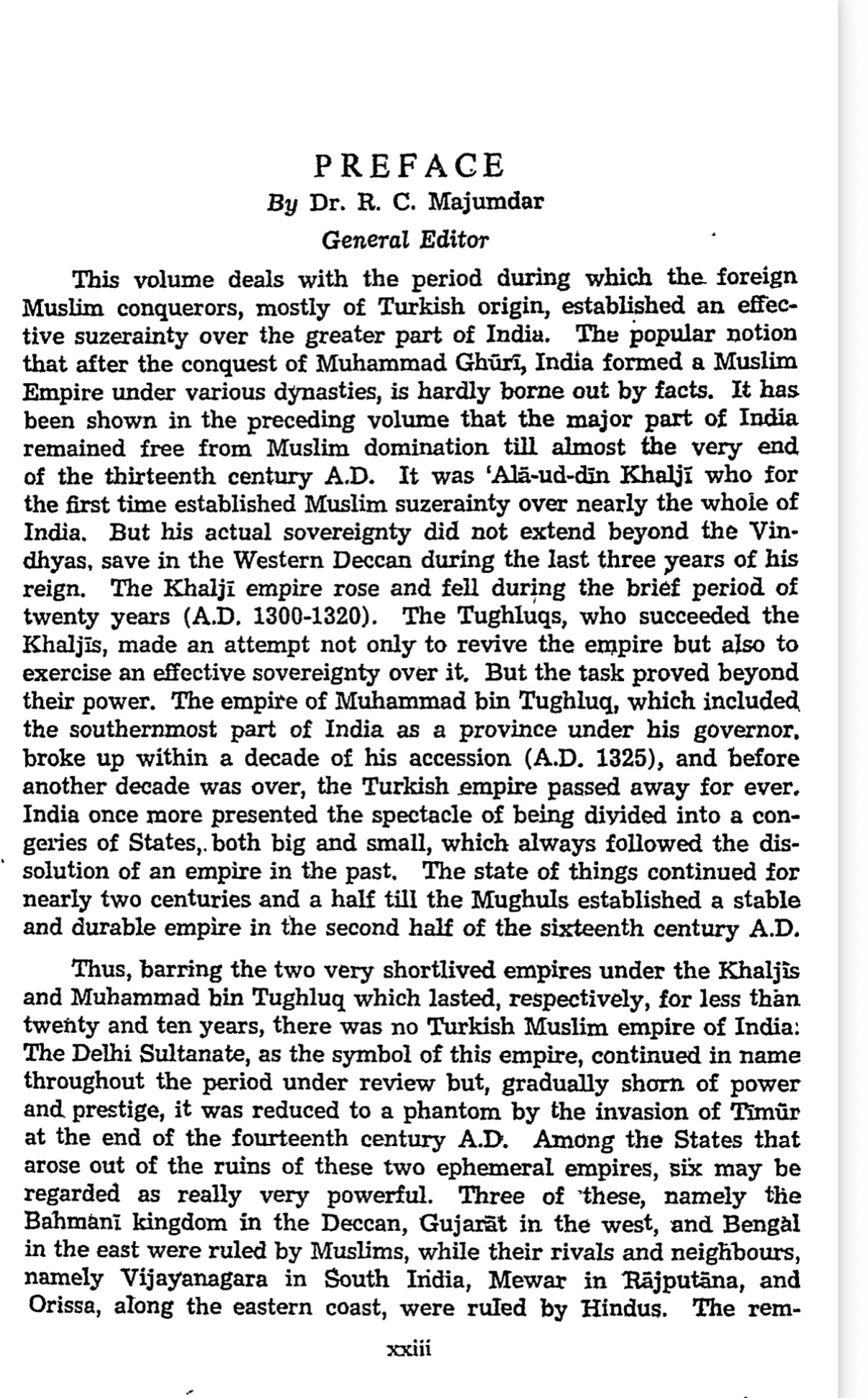
One part I will quote exactly: “Thus, barring the two very shortlived empires under the Khaljis and Muhammad bin Tugluq which lasted, respectively, for less than twenty and ten years, there was no Turkish Muslim empire of India…” . This excerpt is saying that aside from the Khaljis – most prominently Alauddin Khalji – and Muhammad bin Tugluq – it cannot be said there was a Turkish Muslim empire in India. We shall see later in this essay that in can be called into question where exactly Muhammad bin Tugluqs alliegances were directed – and the portion of the actual Turkish Muslim empire can be reduced to simply the ten years of the Khaljis.
There is a text called the Prabhanda Chintamani by Merutanga. Merutanga was a Jain scholar living in Gujurat. It was compiled in 1304 CE. This puts it squarely in the time period of the Delhi Sultanate. Within the text there are a number of anecodotes of kings, ministers, sages, and regular people in Gujarat and surrouding areas. An english translation of the text was done by a man named C. H. Tawney. From the english translation of the text, there is a anecdote that is of importance for our purpose:
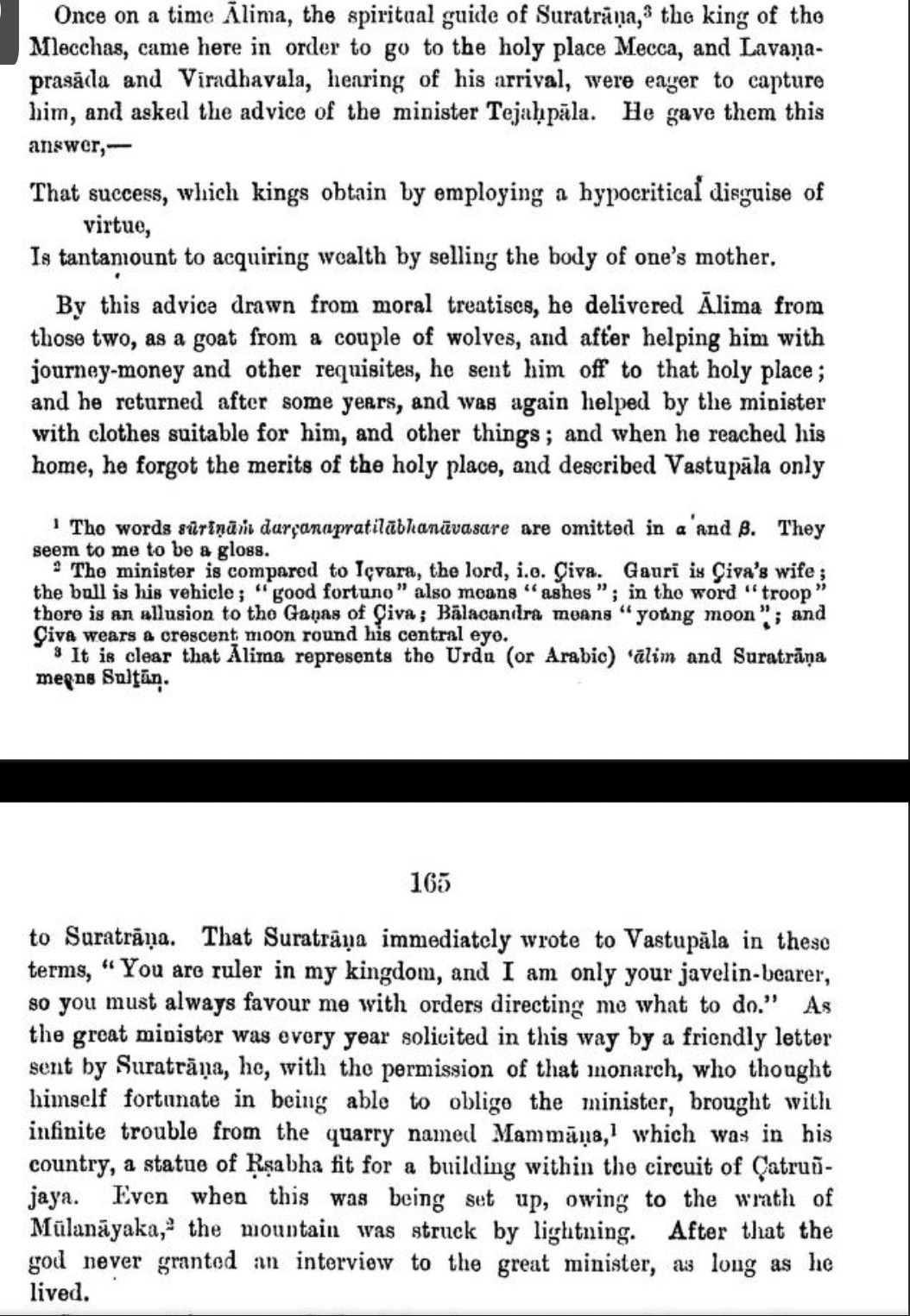
Let us describe the above excerpt. Vastupala and Tejahpala were prominent brothers and Jain ministers of the Vaghela Dynasty of Gujurat in the 13th century. In this excerpt, a Muslim traveller described as the spiritual guide of the king of the mlecchas has appeared in their kingdom. The Muslim traveller intended to make a pilgrimage to Mecca. He is named as “alima”. The translator of the work in the footnote surmises that this must be Ulema – a muslim scholar. Two people, Lavanaprasada and Viradhavala, intended to capture the Muslim traveller. Lavanaprasada and Viradhavala were prominent members of the Vaghela dynasty. The situation was described as a goat (the muslim traveller) surrounded by two wolves (Lavanaprasada and Viradhavala). The minister Tejahpala steps in and prevents the Muslim traveller from being accosted, offers help with journey money and other things, and sends the traveller off to Mecca. The alima is so amazed by this that he told “Suratrana” of the ministers kindness. In a footnote by the translator, Suratrana is said to be another form of the word “Sultan”. Any insightful reading of this text would come to the same conclusion, based on all the evidence. The Sultan then writes to Vastupala (the minister of the Gujurati Kingdom). The sultan says: “You are ruler in my kingdom, and I am only your javelin-bearer, so you must always favour me with orders directing me what to do.” He wrote these types of letters every year.
So what do we have here? The Sultan of delhi has written yearly letters to a Hindu dharmic Gujurati kingdom that he is their javelin-bearer and that they are ruler of his kingdom. In other words, we have evidence that the Sultan of Delhi has made himself a vassal state to a Hindu/Jain Gujurati kingdom. If we find a mention in one mediveal Islamic source that this Rajput kingdom or this other Hindu Kingdom is a vassal state of the Delhi Sultanate then it becomes widely propogated in the sphere of general knowledge, Wikipedia, various websites and writings on history. Yet if we find evidence of the Delhi Sultanate being a vassal of a Hindu kingdom – we don’t find mention of it in any popular writings.
Now I come to a documented historical record of valiant Hindu resistance to the Delhi Sultanate. There are many others, however I am choosing to discuss this particular one. There was a series of contentious skirmishes and war between Alauddin Khalji of the Delhi Sultanate and on the other side the Hindu Rajput kingdom of Ranthambore (in Rajasthan) under Hammir Dev Chauhan. Hammiradeva was a Rajput king of the Chahamana dynstasy. The war happened around 1301 CE. This war and some information on the predecessors of Hammiradeva are entailed in depth in the text “Hammira Mahakavya“ by the Jain scholar Nayachandra Suri. It is thought to have been composed around 1401 CE. The english translation I will refer to was written by Nilkanth Janardan Kirtand. To start with, predecessors of Hammiradeva are talked about. One person of note among the ancestors is Prithviraj Chauhan. His name may be known to many of you readers. Prithviraj Chauhan came into conflict with Muhammad of Ghor (known in the text as Shahabn’d-din). The conflict started when a group of Indian kings harassed by Muhammad of Ghor’s forces went to talk to Prithviraj. The representative of the kings told him the Muslim Muhammad of Ghor had pillaged and burned many of their cities and had defiled their women. Here we get one example of invading Islamic armies mistreatment and rape of women. Prithviraj Chauhan and Muhammad of Ghor go on to fight a number of battles.
The contests between Hammiradevas ancestors and the Muslim forces in India continue over time. Then we come to the time of Hammiradeva. His mothers name is Hira Devi. The enmity between the Hindu and Muslim forces and the future role of Hammiradeva is evident from the following quote: “In course of time, Hira Dévi was found to be with child. Her cravings in this condition presaged the proclivities and greatness of the burden she bore. At times she was possessed with a desire to bathe herself in the blood of the Muslims” (page 26) . The conflict between Hammiradeva’s forces and Alauddin Khalji’s forces began with the causes of Hammiradevas offering asylum and safe space to Mongol chiefs that rebelled against Alauddin Khalji. Hammiradeva also refused to pay tribute to Alauddin Khalji of the Delhi Sultanate. A series of battles ensued. Eventually Alauddin Khalji and his forces laid siege to Hammiradeva’s stronghold of Ranthambore. “The contest that ensued was furious and desperate in the last degree. During these two days the Muhammadans lost no less than 85,000 men” (page 40). Over the course of two days of fighting at Ranthambore, the invading Muslim forces lost over 85,000 men. In reading different Islamic historians accounts of the Islamic invasions of Indias, you hear of mass killings of the native Hindus, Sikhs, Buddhists and Jains en masse: 40,000 in this instance, 100,000 people killed in this other instance. However when we look at Hindu/dharmic sources we get a different picture. 85,000 of the invading Islamic forces were killed. The difference is, the dharmic sources point to a large number of deaths of invading forces intent on killing or converting the native inhabitants; while the Islamic sources speak of mass killings of civilians. The siege of Ranthambore continued. After some time, due to Hammiradeva’s sometimes harsh and untimely actions, some of Hammiradeva’s close allies defected to Alauddin Khalji’s side. At the end, Hammiradeva, along with his remaining generals and followers, went out and fought to the death against the invading army. The women of the royal family commited jauhar – self immolation to avoid falling into enemy hands.
Now I shall discuss some interesting facets of the Hindu-Muslim power dynamics during the period of the Delhi Sultanate. Near the beginning of this essay I quoted a source that said the Turkish Muslim Delhi Sultanate could really only be called an empire for 20 years under the Khaljis and for ten years under Muhammad bin Tugluq. So one of the periods under which the Delhi Sultanate could be considered to be at it’s most expanisve was under Muhammad bin Tuqluq. I shall delve deeper into the information on this Sultan of Delhi. To start with, the book The Delhi Sultanate by Bharatiya Vidya Bhavan says about Muhammad bin Tuqluq: “According to Bharani the Sultan ‘wantonly shed the blood of innocent Muslims, so much so indeed that a stream of blood was always seen flowing before the threshold of the palace’ ” (page 82). The text goes on to describe how Muhammad bin Tugluq did not refrain from targeting even Islamic scholars and learned men. Perhaps this is simply an example of a man, who while being an orthodox Islam, sometimes happened to target other muslims due to differences of opinions, clashes of personality, or other such reasons. However the real answer is different than this hypothesis. In the aforementioned Bharati Vidya Bhavan’s book:
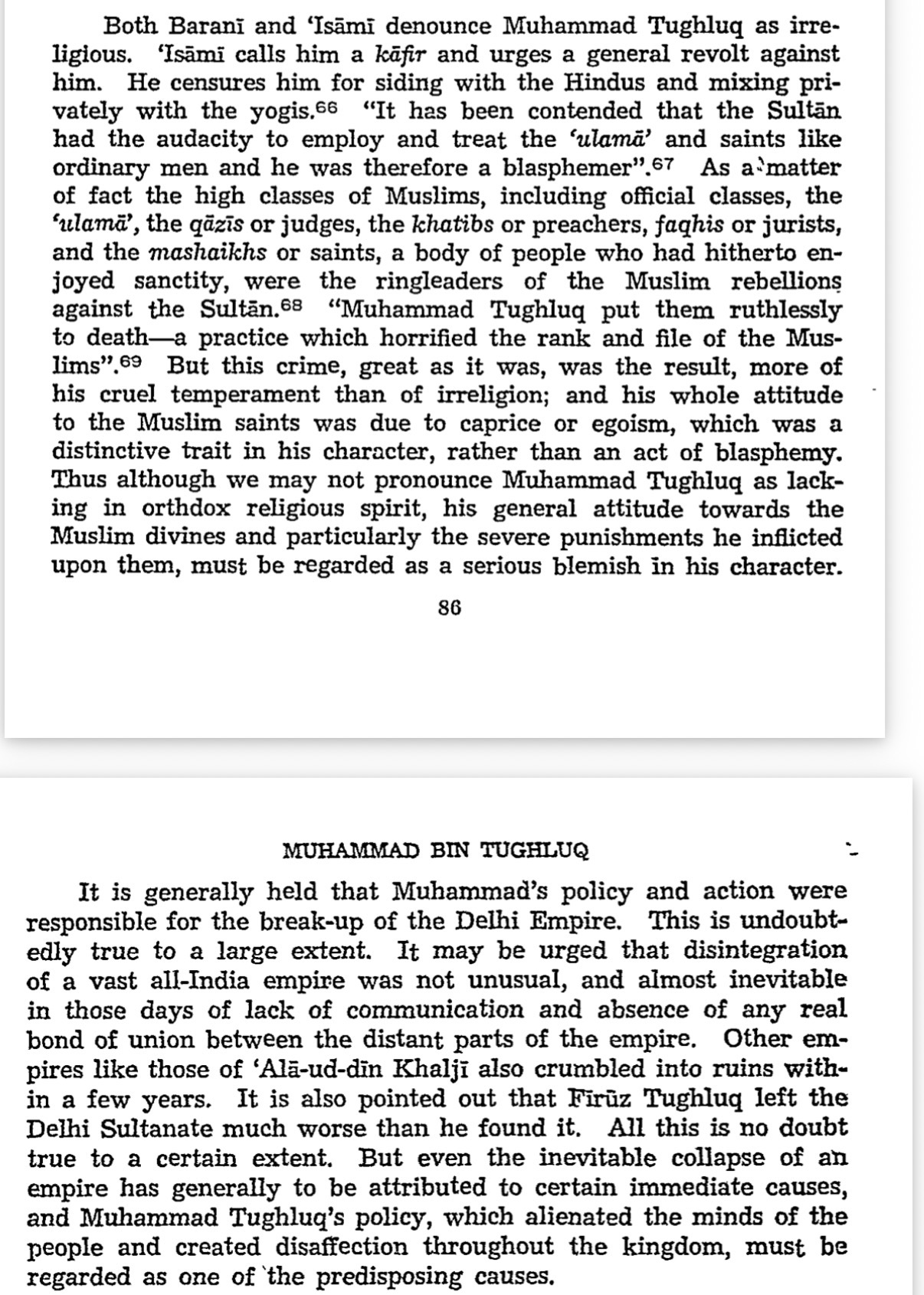
Of note, the book says: “Both Barani and Isami denounce Muhammad Tugluq as irrelgious. Isami calls him a kafir and urges a general revolt against him. He censures him for siding with the Hindus and mixing privately with the yogis” (page 86). So we have evidence that the head of the Delhi Sultanate was viewed as an infidel by certain elements of the orthodox muslims. He was known to mix with Hindu yogis. And he was violent towards all types of muslims. The picture becomes much more interesting rather than simply an abrasive personality. What forces was he influenced by? In a more informal online source, it was stated: “Isami says that Sultan Muhammad Bin Tughluq crushed the Muslims in the attempt to appease the Hindus.” (https://www.jetir.org/papers/JETIR1905W33.pdf) . I was not able to find a full english translation of Isami’s work (mentioned twice above) – from what I have read it has interesting information on Hindu-Muslim power dynamics during the Delhi Sultanate.
So far I have covered in part some aspects of the reality of Muslim rule during the Delhi Sultanate, valiant resistance to the Delhi Sultanate, and Hindu-Muslim power dynamics during the time period. I intend to add to this writing at some point.
To Be Continued…